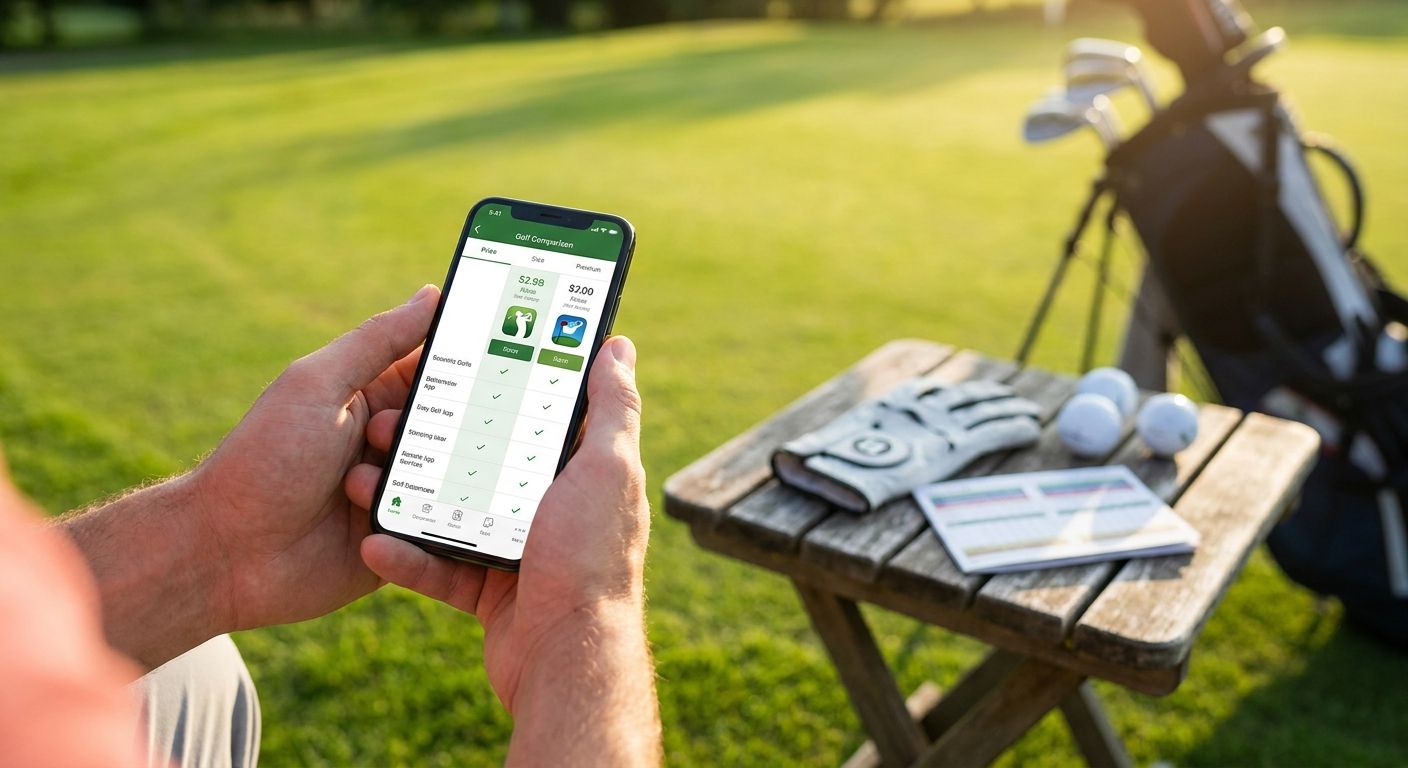
Arccos Caddie wins overall for tracking fairways and greens in regulation because its sensors log every shot automatically instead of relying on you to remember what happened on hole 14. Shot Scope is the pick for hands-free wearable tracking. Golf Pad GPS is the budget option that still gets FIR and GIR right. If your group cares more about sharing round results in a group chat than parsing shot-level data, LFG Golfing covers that angle instead.
- Arccos Caddie is the best golf app fairways greens in regulation tracker for 2026 because sensors auto-log every shot.
- Shot Scope wins for hands-free tracking via wrist sensor, no phone pulls between shots.
- Golf Pad GPS is the strongest budget pick that still separates FIR from GIR accurately.
- 18Birdies and Golfshot both track FIR/GIR manually but add GPS rangefinder and social features.
- LFG Golfing is built for logging rounds and sharing stat cards with your group, not granular shot tracking.
Why this matters
Fairways in regulation (FIR) and greens in regulation (GIR) are the two stats that actually predict your score, more than putts made or total distance off the tee. You hit a fairway in regulation when your tee shot on a par 4 or par 5 lands on the short grass. You hit a green in regulation when you reach the putting surface in par minus two strokes — par minus one on a par 3, since you only get one shot to get there.
Most golfers overestimate both numbers by 15-20 percentage points because they're guessing from memory after the round instead of logging in real time. An app fixes that, but only if it captures the shot the moment it happens instead of asking you to reconstruct 18 holes from a scorecard in the parking lot.
What makes the best golf app for fairways and greens in regulation
- Automatic vs. manual capture. Sensor-based apps log shots without you touching your phone; manual apps need a tap after every shot or they lose accuracy.
- FIR/GIR split reporting. The app should separate fairway hits from green hits, not bury both inside one vague "accuracy" score.
- Strokes gained context. Knowing you missed 6 of 14 fairways matters more when it's tied to strokes lost against your handicap.
- GPS rangefinder accuracy. Distance-to-pin numbers feed directly into whether you count a shot as "in regulation."
- Round-to-round trend view. A single round tells you little; the trend over 10-20 rounds tells you where to practice.
- Sharing and group visibility. Some golfers want raw stat depth; others want a clean card to drop in the group chat after the round.
Golf apps for fairways and greens in regulation, at a glance
| App | Best for | Standout feature | Key limitation |
|---|---|---|---|
| Arccos Caddie | Automatic FIR/GIR tracking | Sensor-based shot detection, no manual tagging | Requires sensors on every club to work fully |
| Golfshot | GPS rangefinder + manual FIR/GIR | Detailed hole-by-hole stat breakdown | Manual entry means missed taps skew data |
| Shot Scope | Hands-free wearable tracking | Wrist sensor logs shots without touching your phone | Setup and pairing takes longer than app-only tools |
| 18Birdies | Social scoring and round sharing | Built-in community challenges and leaderboard | FIR/GIR detail is lighter than sensor-based rivals |
| Golf Pad GPS | Budget-friendly GPS and stat tracking | Clean GPS rangefinder with solid manual stat entry | Fewer advanced analytics than premium competitors |
| LFG Golfing | Group trip logging and stat sharing | Shareable stat cards built for group chats | Not built for shot-level FIR/GIR tracking |
1. Arccos Caddie: best golf app for automatic fairway and GIR tracking
Arccos Caddie pairs sensors on your clubs with GPS to log where every shot lands, then classifies it against fairway and green boundaries without you tapping anything mid-round. That's the core reason it tops this list for 2026: the FIR/GIR numbers reflect what actually happened, not what you remember on the 19th hole.
Arccos Caddie pros:
- Fully automatic shot detection removes manual entry error
- Strokes gained data ties FIR/GIR misses to actual score impact
- Round trends build over time without extra work from you
Arccos Caddie cons:
- Needs sensors on your clubs to unlock full automatic tracking
- Setup takes longer than a download-and-play app
Best for: golfers who want hands-off, sensor-accurate FIR/GIR data. Verdict: Buy.
2. Golfshot: best golf app for GPS rangefinder plus manual FIR/GIR logging
Golfshot combines a GPS rangefinder with a stat-tracking layer that lets you tag fairway and green results hole by hole. It's a step down from sensor automation but a step up in rangefinder detail compared to most stat-only apps, which is why it earns a distinct slot on this list.
Golfshot pros:
- Rangefinder and stat tracker in one app
- Hole-by-hole breakdown makes post-round review fast
- Works without extra hardware
Golfshot cons:
- Manual tagging means a missed tap throws off your GIR percentage
- Less automatic than sensor-based competitors
Best for: golfers who want rangefinder distances and FIR/GIR in one place without buying sensors. Verdict: Buy.
3. Shot Scope: best golf app for hands-free wearable tracking
Shot Scope's wrist-worn device tags each shot location automatically, so the FIR/GIR data collects itself while your phone stays in the bag. That's the entire pitch, and it works for golfers who find pulling a phone out mid-swing routine annoying.
Shot Scope pros:
- Hands-free logging via wearable sensor
- No phone interaction needed during the round
- Data syncs after the round for full review
Shot Scope cons:
- Initial pairing and setup takes more time than app-only options
- Wearable adds another piece of gear to remember
Best for: golfers who don't want their phone out on the course. Verdict: Buy.
4. 18Birdies: best golf app for social scoring and round sharing
18Birdies leans into community features — challenges, leaderboards, round sharing — with FIR/GIR tracking built in as part of the scorecard rather than the headline feature. It fills a different slot than the sensor-heavy apps above: golfers who want engagement and social proof alongside their stats.
18Birdies pros:
- Built-in community challenges keep casual golfers engaged
- Scorecard sharing is simple and quick
- FIR/GIR tracking is included without extra setup
18Birdies cons:
- Stat depth is lighter than dedicated sensor-based trackers
- Manual entry still required for accurate FIR/GIR numbers
Best for: golfers who want social features alongside basic FIR/GIR tracking. Verdict: Hold if stat depth matters more than community features.
5. Golf Pad GPS: best budget golf app for fairways and greens in regulation
Golf Pad GPS delivers a clean rangefinder and manual stat tracker without the premium feature stack of Arccos or Shot Scope. For golfers who want reliable FIR/GIR logging without buying sensors or a wearable, this is the lean option.
Golf Pad GPS pros:
- Straightforward GPS rangefinder
- Manual FIR/GIR entry is quick per hole
- No extra hardware required
Golf Pad GPS cons:
- Fewer advanced analytics than sensor-based competitors
- Manual tracking still depends on you tapping accurately
Best for: budget-conscious golfers who still want accurate FIR/GIR splits. Verdict: Buy.
6. LFG Golfing: best for logging rounds and sharing stat cards with your group
LFG Golfing is built for a different job than the five apps above: logging every course you play, tracking group golf trips with friends, and turning results into shareable stat cards for the group chat. It's not a shot-level FIR/GIR tracker, and it doesn't pretend to be — it's the layer that turns a weekend trip into something your foursome actually looks back at.
LFG Golfing pros:
- Logs every course played across a season or a trip
- Generates stat cards built specifically for group chat sharing
- Keeps group golf trips organized in one place
LFG Golfing cons:
- No shot-level FIR/GIR or strokes gained tracking
- Best paired with a dedicated stat tracker if you want granular fairway and green data
Best for: groups who care more about trip history and shareable cards than shot-by-shot analytics. Verdict: Buy if group tracking is the priority; Skip if you need granular FIR/GIR data alone.
Log your next golf trip
Track courses played and share stat cards with your group after the round.
How we ranked these golf apps
Each app was weighed against the six criteria above: capture method, FIR/GIR split reporting, strokes gained context, GPS accuracy, trend tracking, and sharing features. Apps that automate shot capture ranked above apps that rely on manual entry, since manual tagging is the single biggest source of bad FIR/GIR data in 2026 rounds.
“An app only fixes your fairway and green stats if it captures the shot the moment it happens, not after you've already forgotten it.”
Which golf app should you choose for FIR/GIR tracking?
If you want the most accurate fairway and green in regulation numbers with zero manual work, Arccos Caddie is the 2026 default. Want that data without a wearable pairing process? Golfshot gets you close with a rangefinder built in. On a budget, Golf Pad GPS still splits FIR from GIR cleanly.
If the real goal is keeping your group's trip history and sharing results without touching spreadsheet-level stats, LFG Golfing is the better fit — it's built for logging courses and generating cards for the group chat, not for parsing shot dispersion.
FAQ
What's the best golf app for tracking fairways and greens in regulation in 2026?
Arccos Caddie is the best overall pick for 2026 because its club sensors log shots automatically instead of relying on manual entry. Shot Scope is the top wearable alternative, and Golf Pad GPS is the strongest budget option.
Is Arccos Caddie better than Golfshot for FIR/GIR tracking?
Arccos Caddie is more accurate because sensors detect shots automatically, while Golfshot relies on manual tagging after each shot. Golfshot is a solid choice if you don't want to buy club sensors.
How is greens in regulation calculated?
You hit a green in regulation when you reach the putting surface in par minus two strokes, or par minus one on a par 3. It's the standard measure of ball-striking quality used across golf apps and tour stat sheets.
Does LFG Golfing track fairways and greens in regulation?
No. LFG Golfing is built for logging every course you play and generating shareable stat cards for group trips, not shot-level FIR/GIR tracking. Pair it with a dedicated stat tracker if you need granular fairway and green data.
Do I need a wearable sensor to track FIR/GIR accurately?
No, but it helps. Wearables like Shot Scope and sensor kits like Arccos Caddie remove the manual tagging step that causes most inaccurate FIR/GIR readings in app-only trackers.
What's the difference between a fairway in regulation and a green in regulation?
Fairway in regulation means your tee shot lands in the fairway on a par 4 or par 5. Green in regulation means you reach the putting surface in par minus two strokes, regardless of where your tee shot landed.
Which golf app is best for sharing round results with a group?
LFG Golfing is built specifically for that use case, turning logged rounds into stat cards designed for group chat sharing. Apps like 18Birdies also offer social sharing but with a lighter focus on group trip history.
One last thing
Most golfers who start tracking FIR/GIR in 2026 find their actual fairway percentage is 15-20 points lower than what they'd guessed from memory — the gap is almost always missed short-side approach shots, not the big misses you remember. Track ten rounds before you trust the trend line; one bad round skews the average more than you'd think.